


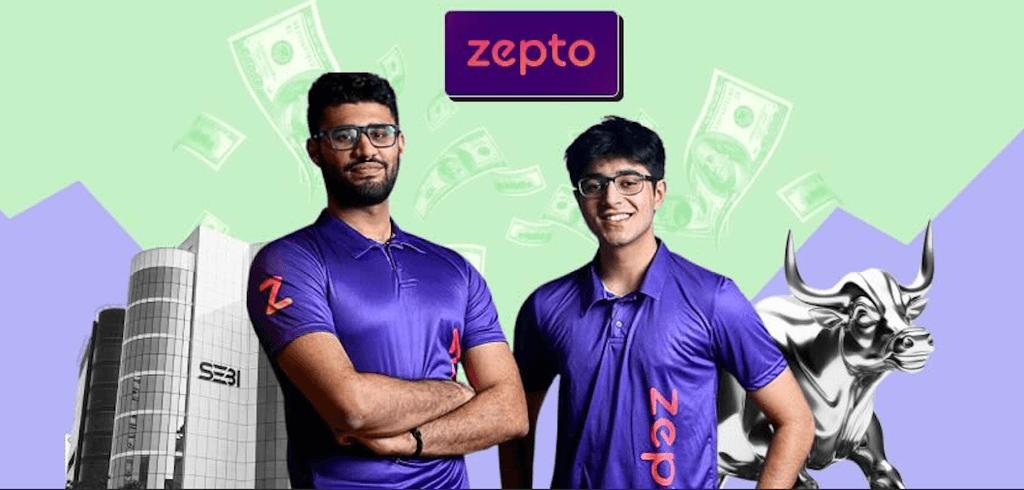
Founded in 2021 by two Stanford-bound teenagers, Zepto turned an audacious promise — groceries in 10 minutes — into a $5 billion company rewriting the rules of Indian quick commerce.
Born in 2001, Aadit dropped out of Stanford to build Zepto at age 19 alongside co-founder Kaivalya Vohra. Previously founded KiranaKart — which shut down during COVID — he used the failure as a launchpad, doubling down with a radically faster model. He is widely considered one of India’s most influential Gen Z entrepreneurs.
Origin
A failed startup that planted the seed
In 2020, Aadit Palicha and Kaivalya Vohra were students with an idea: fix the chaos of local Indian grocery shopping through an app called KiranaKart. It connected customers with neighbourhood kirana stores. The timing was terrible — the pandemic shuttered everything — and the startup folded.
But the failure taught them something invaluable. Indians didn’t just want convenience — they wanted now. Not same-day. Not two hours. Now. The insight led them to a different model entirely: instead of partnering with existing stores, they would build their own network of micro-warehouses, stocked precisely, placed strategically, and optimised for a single metric — getting groceries to a customer’s door in 10 minutes flat.
“We weren’t trying to be Swiggy or Amazon. We were building a completely new category — one where speed itself is the product.”— Aadit Palicha, Co-Founder & CEO, Zepto
The model
Dark stores: the engine behind the promise
Zepto’s secret weapon is its network of “dark stores” — small, hyperlocal fulfilment centres that are invisible to the public but located within 1–2 km of dense residential zones. Each store stocks roughly 5,000 SKUs, curated by data. Orders flow from a customer’s app to the nearest dark store, where pickers race against the clock.
The logistics are extraordinarily precise. Zepto uses machine learning to predict demand at the SKU level, so stores are restocked before they run out, not after. Delivery riders are stationed close by, minimising last-mile time. Every second is engineered. The result: an average delivery time that has hovered around 10 minutes since day one.
Growth timeline
From idea to India’s fastest unicorn
2021 — Launch
Zepto launches in Mumbai with a handful of dark stores. The 10-minute delivery promise goes viral on social media.
2022 — Series B & C
Raises $360M across two rounds. Expands to Bengaluru, Delhi, Hyderabad, and Chennai. Dark store count crosses 100.
2023 — Profitability push
Zepto shifts focus from growth-at-all-costs to unit economics. Introduces Zepto Cafe (beverages) and Zepto Pass (subscription). Revenue surpasses ₹2,000 crore.
2024 — $5 Billion valuation
Raises $665M in a landmark round, becoming one of India’s youngest unicorns by founder age. 700+ dark stores operational across 10+ cities.
2025–26 — IPO horizon
Prepares for a landmark public offering. Expands into new verticals including electronics and home essentials. Revenue trajectory points toward $1B ARR.
Leadership lessons
What makes Zepto’s founders different
Aadit Palicha is 24 years old. Kaivalya Vohra, the CTO, is 23. Together they run a company with thousands of employees, hundreds of fulfilment centres, and institutional investors including Y Combinator, Nexus Venture Partners, and StepStone Group. The conventional wisdom says experience is everything in building consumer infrastructure. Zepto has quietly demolished that assumption.
What the founders lacked in experience, they replaced with speed of iteration and radical focus. In the early days, Aadit reportedly spent nights personally calling unhappy customers. Kaivalya rebuilt the tech stack multiple times as scale demands changed. Their willingness to discard what wasn’t working — and double down on what was — mirrors the operational intensity of founders decades their senior.
“Our age was never a disadvantage. We just didn’t know what was supposed to be impossible.”— Kaivalya Vohra, Co-Founder & CTO, Zepto
What’s next
The road to India’s largest quick commerce IPO
Zepto is widely expected to go public in the near term, with analysts tracking it as one of the most anticipated Indian tech IPOs in years. The company has expanded beyond groceries into Zepto Cafe, instant pharmacy delivery, and consumer electronics — each leveraging the same dark store infrastructure and logistics muscle built for grocery.
The quick commerce space in India is projected to exceed $10 billion by 2027. Zepto, Blinkit (Zomato), and Swiggy Instamart are the three dominant players in a race that is reshaping how 1.4 billion people think about shopping. In this race, Zepto’s edge remains what it always has been: speed, obsession with operations, and two founders young enough to believe the impossible is just an engineering problem.
© 2026 Corporate Insights. All figures are based on publicly available funding disclosures and industry reports. This article is for informational purposes only.