


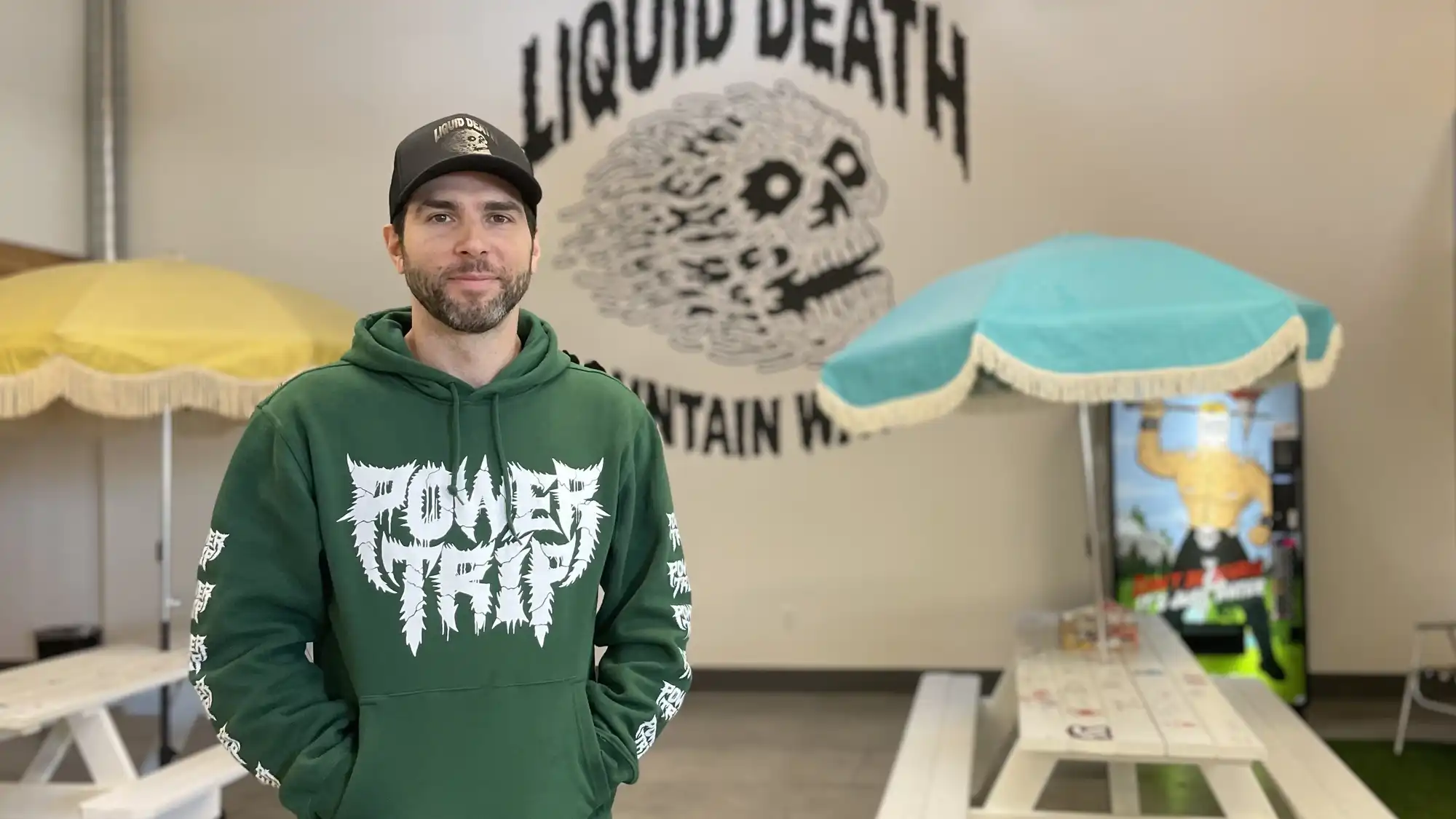
Mike Cessario sold water in a tallboy beer can, named it like a death metal band, and convinced the world’s biggest retailers to stock it. Liquid Death is the most unlikely unicorn of the decade — and possibly the most brilliantly marketer.
Mike Cessario Co-Founder & CEO, Liquid Death
A former Netflix creative director and advertising copywriter, Mike Cessario spent years making content for brands before realising the most interesting brand he could build was one that actively mocked brand culture. He launched Liquid Death from Los Angeles in 2019 with a single Facebook video, $0 in paid advertising, and a name that every investor told him was insane. He was right, and they were wrong.
Origin
The idea that started as a joke
In 2009, Mike Cessario was at a Warped Tour music festival watching bands perform. He noticed something: the musicians on stage were all drinking water, but the water came in plastic bottles with cheerful pastel labels. It looked absurd next to the mosh pit. He thought: what if water came in something that actually fit the culture — a metal tallboy can, like a craft beer, with a name that sounded dangerous?
He filed the thought away for a decade. By 2018 he was working as a creative director at Netflix, making trailers and ad campaigns. The idea resurfaced. He mocked up a can, shot a quick irreverent video, posted it to Facebook without spending a dollar on promotion — and it racked up 3 million views in weeks. The market had spoken before the product even existed.
Cessario quit his job and incorporated Liquid Death Mountain Water in 2019. The pitch to investors was simple and savage: water is a commodity, but culture is not. If you can make people feel something when they pick up a can of water — identity, rebellion, dark humour — you have a brand that no amount of Evian marketing budget can touch.
“People said nobody will buy water in a can called Liquid Death. Those same people now work for us.”— Mike Cessario, Co-Founder & CEO, Liquid Death
The product
It’s just water. That’s the whole point.
Liquid Death is, at its core, mountain spring water and sparkling water, sourced from the Austrian Alps, packaged in infinitely recyclable aluminium cans. The water itself is unremarkable. The brand is not.
The cans look like energy drinks or craft beers. The tagline is “Murder Your Thirst.” The company sells merchandise — hoodies, skateboards, coffins — that people actually buy and wear. It has signed partnerships with Tony Hawk, Martha Stewart, and Travis Barker. It released a limited-edition “Convicted Felon” sparkling water flavoured with real prison commissary candy. It auctioned off a painting made with Ozzy Osbourne’s blood. Every campaign is engineered to be so strange that media covers it for free.
Sustainability as punk rock
Aluminium cans are recycled at nearly five times the rate of plastic bottles. Liquid Death turned this environmental fact into a core brand identity — “Death to Plastic” — making sustainability feel rebellious rather than preachy. It donates 10% of profits to environmental causes and has partnered with nonprofits to clean up plastic pollution worldwide.
Growth timeline
From a Facebook video to a billion-dollar can
2018 — The video
Cessario posts a mock brand video on Facebook before the product exists. It earns 3 million organic views and validates the concept entirely.
2019 — Launch
Liquid Death launches online only. Sells out immediately. Raises $2.25M in seed funding despite widespread investor scepticism about a water brand with a death metal name.
2020 — Whole Foods & beyond
Secures its first major retail partnership with Whole Foods. Pandemic-era boom in canned beverages accelerates growth. Revenue doubles month over month.
2021 — $500M valuation
Raises $75M at a $500M valuation. Expands into Target, 7-Eleven, and Whole Foods nationwide. Launches sparkling flavoured water line.
2023 — $700M+ & profitability
Revenue hits $263M. Reaches 113,000 retail locations. Launches iced teas and lemonade. Reports its first profitable quarter.
2024 — $1.4 Billion unicorn
Raises $67M at a $1.4B valuation. Becomes the fastest-growing non-alcoholic beverage brand in the United States. IPO conversations begin.
What they got right
The Liquid Death playbook
Entertainment, not advertising
Every piece of Liquid Death content is made to be shared, not seen. Campaigns are so absurd they generate press coverage worth millions in free media.
Identity over product
Nobody buys Liquid Death because the water is better. They buy it because of what it says about them. The can is a social signal, not a hydration solution.
Values with an edge
Sustainability is core — but never earnest. “Death to Plastic” is a battle cry, not a corporate pledge. Purpose-driven without being preachy is a masterclass in modern branding.
Merch as a media channel
Liquid Death sells skateboards, hoodies, and limited-edition art. Fans become walking billboards. Merchandise revenue is a bonus; the brand impressions are the point.
What’s next
The most counter-intuitive IPO in beverage history
Liquid Death is expanding its product line — iced teas, lemonades, and flavoured sparkling waters — turning from a single-SKU curiosity into a full beverage portfolio under one irreverent banner. The goal is not to replace Coca-Cola. It is to own the cultural space between craft beer and energy drinks for a generation that doesn’t drink alcohol the way their parents did.
The company faces real challenges: premium water is a crowded space, aluminium cans are heavier and more expensive to ship than plastic, and the joke eventually has to sustain itself at scale. But Cessario has consistently proven that the category rules don’t apply to Liquid Death, because Liquid Death isn’t really in the water category. It’s in the culture business.
When the IPO comes — and it likely will — it will be one of the most watched consumer brand listings in years. Not because of the water. But because an industry will want to understand how a man with a Facebook video and a darkly funny name for a can of mountain spring water convinced over 100,000 retailers, Tony Hawk, Martha Stewart, and $1.4 billion worth of investors to take him seriously.
“We don’t make water. We make content. The water is just what the content comes in.”— Mike Cessario, Co-Founder & CEO, Liquid Death
© 2026 Enterprise Insider. Figures based on publicly available funding disclosures, company announcements, and industry reports. This article is for informational and editorial purposes only.