


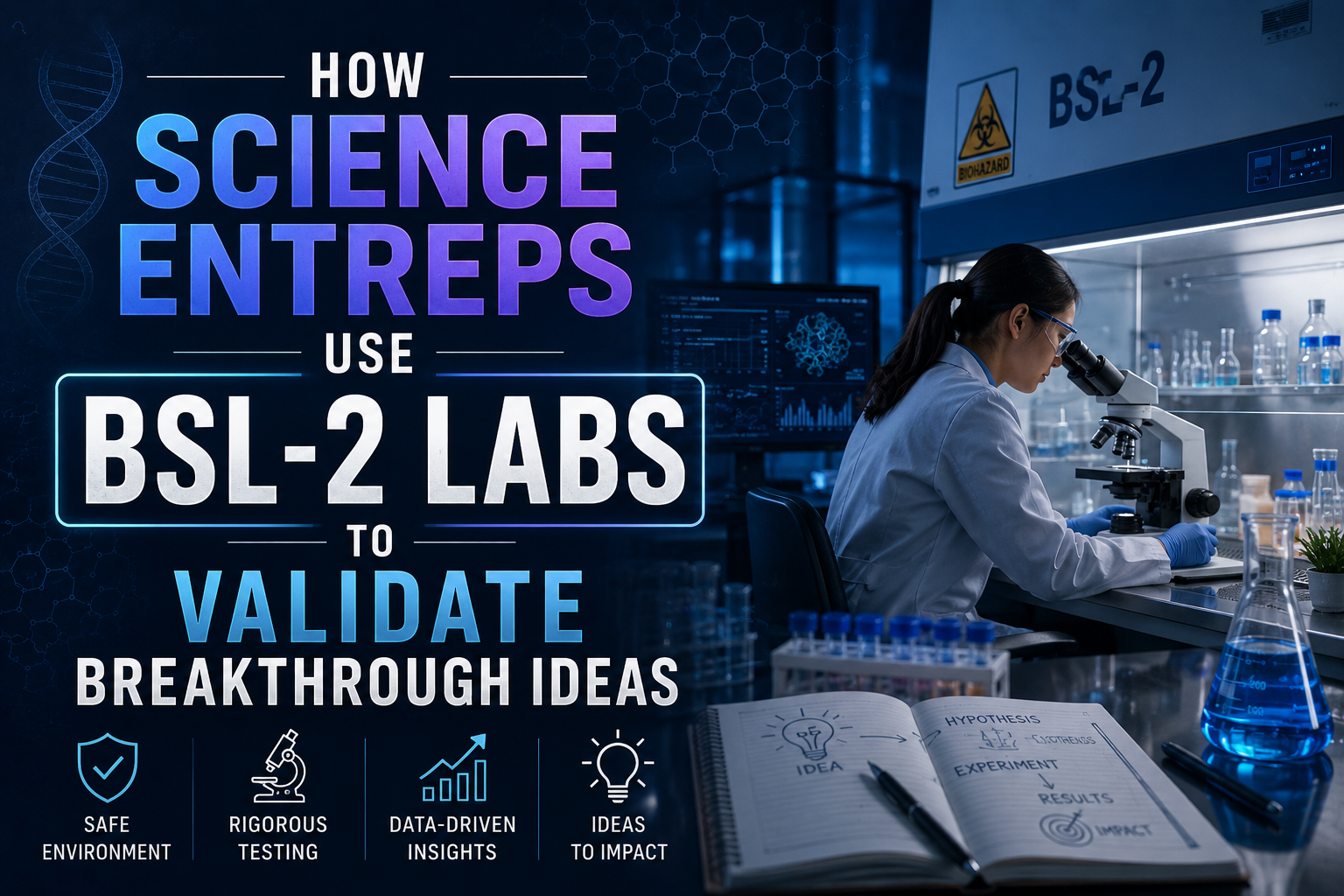
Scientific innovation often begins with a promising concept, but turning that idea into something
credible requires careful validation. For science entrepreneurs, this stage is particularly critical.
Investors, regulators, and potential partners all expect evidence that a concept works safely and reliably
under controlled conditions. Without this proof, even the most exciting discovery may struggle to gain
support.
Access to appropriate laboratory facilities plays a central role in this process. Many early-stage
innovators do not have the resources to build specialised laboratories from the ground up, especially
when their work involves biological materials. As a result, they often look for facilities that already meet
regulatory standards and provide the infrastructure required for safe experimentation.
One such option is the biosafety level 2 (BSL-2) laboratory, a type of facility designed to support
research involving moderate-risk biological agents. For science entrepreneurs exploring ideas in
biotechnology, diagnostics, therapeutics, or applied microbiology, BSL-2 laboratories can provide a
structured environment for turning promising concepts into validated results.
How BSL-2 Labs Support the Validation Process
A BSL2 certified lab offers more than just a physical workspace. These facilities are designed with
specific safety practices, equipment, and operational protocols that enable controlled experimentation
with a wide range of biological materials. When used effectively, they can help entrepreneurs move
from theoretical concepts to reliable experimental data in the following ways:
1) Enabling Controlled Biological Experiments
Many breakthrough ideas in life sciences involve working with biological samples that require
specialised handling. A BSL-2 facility provides containment measures that allow researchers to perform
these experiments safely while maintaining compliance with biosafety standards.
Entrepreneurs developing diagnostic assays, for example, may need to work with human-derived
samples or non-high-risk pathogens to test whether their detection systems function as intended. The
controlled environment of a BSL-2 lab ensures that such work can proceed under clearly defined
protocols. This structure helps teams focus on experimental design while minimising biosafety risks.
At the same time, the laboratory’s design supports reproducibility. The use of standardised equipment,
coupled with proper ventilation systems and established handling procedures, helps ensure that
experimental conditions remain consistent across multiple trials. For innovators attempting to validate a
scientific concept, this consistency is essential for generating reliable data.
2) Supporting Early-Stage Product Development
Breakthrough ideas typically evolve through repeated cycles of testing, refinement, and verification. A
BSL-2 facility allows entrepreneurs to conduct these iterations without needing to move between
different laboratories or compromise on safety requirements.
For instance, a startup exploring a new antimicrobial compound may begin by evaluating its effects on
bacterial cultures. Initial experiments may reveal promising activity, but further work is needed to
understand dosage ranges, stability, and possible interactions with other biological materials. A properly
equipped BSL-2 lab makes it possible for these investigations to continue in the same environment,
effectively streamlining the development process.
In addition, many BSL-2 facilities provide shared equipment that would otherwise be costly for early-
stage companies to acquire. Access to instruments such as incubators, biosafety cabinets, and
centrifuges allows entrepreneurs to conduct complex biological workflows without the immediate
capital investment required to build a fully independent laboratory.
3) Building Credibility through Structured Research
For science entrepreneurs, validation is not only about proving that an idea works. It is also about
demonstrating that the research behind the idea follows recognised scientific practices.
Work conducted in a BSL-2 environment often adheres to established biosafety guidelines and
institutional oversight. This structured framework can strengthen the credibility of experimental findings
when entrepreneurs present them to potential investors, collaborators, or regulatory bodies.
Data generated within such facilities may also carry more weight during early discussions with industry
partners. When results come from experiments conducted in compliant laboratory environments, they
signal that the research process has been carried out responsibly. This perception can make it easier for
entrepreneurs to build trust as they move their ideas closer to commercial development.
Opportunities and Limitations of Using BSL-2 Facilities
While BSL-2 laboratories offer important advantages, they are not suitable for every type of project.
Science entrepreneurs must weigh both the opportunities and the constraints before deciding whether
this environment fits their validation strategy.
Opportunities
Several factors make BSL-2 laboratories attractive for early-stage innovators who need reliable
experimental environments but may not yet have their own infrastructure, and these include the
following:
● Greater accessibility for startups and early-stage teams. Compared with higher biosafety levels,
BSL-2 facilities are more widely available in research institutes and incubators. This accessibility
allows entrepreneurs to begin validating their ideas without having to invest in constructing
specialised laboratories from the outset.
● A practical balance between safety and experimental flexibility. BSL-2 laboratories are designed
to handle biological agents that present moderate hazards, which include many microorganisms
and biological materials commonly used in life science research. This scope allows innovators to
explore their work’s applications in multiple areas while maintaining appropriate safety controls.
● Access to specialised equipment and laboratory infrastructure. Shared BSL-2 facilities often
include instruments and containment systems that early-stage companies might otherwise
struggle to obtain. This allows them to focus on testing and refining their ideas rather than
investing heavily in laboratory infrastructure.
Limitations
Despite these advantages, BSL-2 laboratories also come with boundaries that science entrepreneurs
need to recognise when planning their validation efforts.
● Restrictions on high-risk biological agents. BSL-2 facilities are not designed for work involving
highly infectious or dangerous pathogens. Projects that require these organisms must be
conducted in higher-level containment environments such as BSL-3 or BSL-4 laboratories.
● Operational protocols and compliance requirements. Work conducted in BSL-2 laboratories
follows established biosafety procedures, including training requirements, waste disposal
protocols, and laboratory conduct guidelines. While these measures are essential for
maintaining safety, they can introduce administrative responsibilities for startup teams that are
unfamiliar with laboratory compliance processes.
● Costs associated with shared laboratory access. Although using a shared BSL-2 facility is
generally more affordable than building a private laboratory, it still involves financial
commitments. These can include membership fees and equipment usage charges.
In the end, scientific innovation moves forward when ideas are tested, challenged, and refined through
careful experimentation. For science entrepreneurs, this validation process represents a bridge between
theoretical discovery and real-world application.
Facilities such as BSL-2 laboratories provide an environment where emerging concepts can be explored
safely while generating credible scientific evidence. When used strategically, these facilities become
valuable stepping stones that help transform promising breakthroughs into validated technologies ready
for further development.