


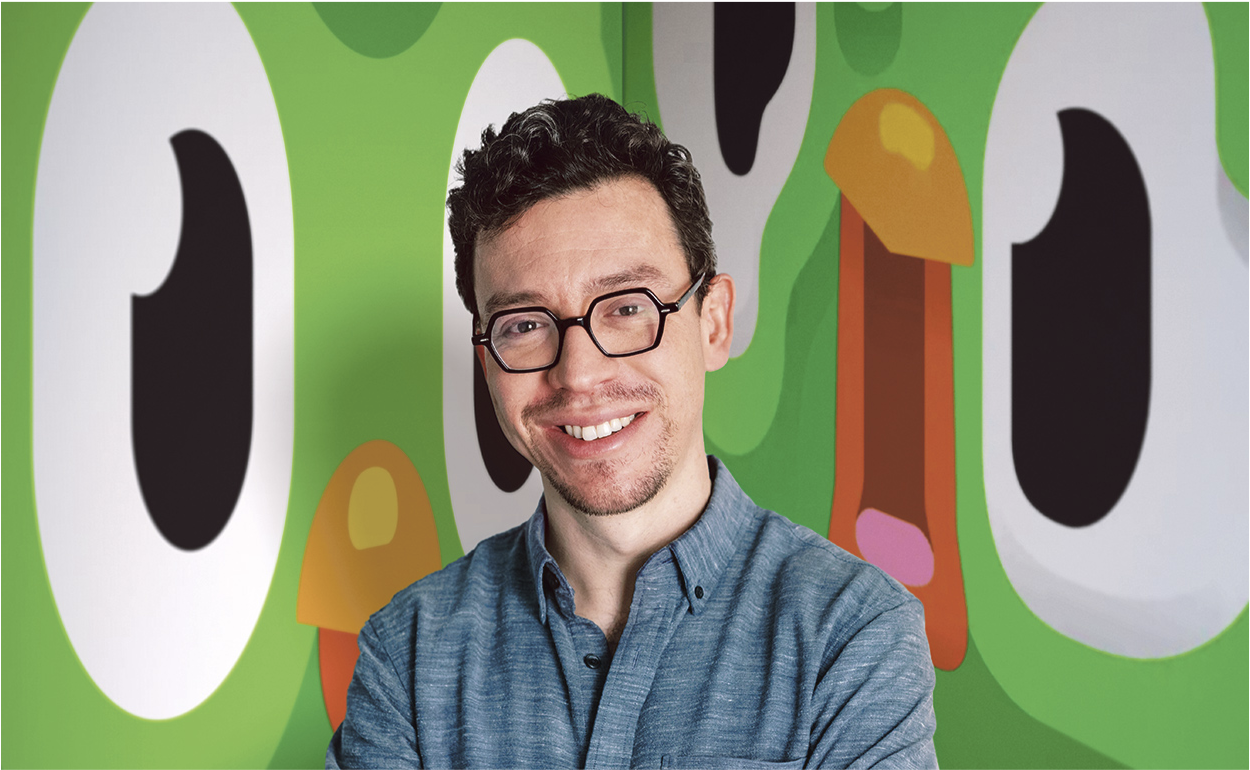
Duolingo: How a Kidnapping Survivor from Guatemala Built the World’s Most Downloaded Education App
Luis von Ahn survived a kidnapping attempt as a child, won a MacArthur Genius Grant as an adult, sold two companies to Google — and then built a green owl that guilt-trips half a billion people into learning languages every day.
Born in 1978 in Guatemala City, Luis von Ahn grew up in a wealthy family that was targeted by kidnappers — an experience that shaped his drive to create impact beyond his own country. He earned his PhD in computer science from Carnegie Mellon, won a MacArthur Fellowship at 27, and invented reCAPTCHA and CAPTCHA — both later acquired by Google. He is now a full professor at CMU and the CEO of one of the most-used apps on earth, driven by a single mission: free, world-class education for everyone.
Origin
From CAPTCHA to classrooms: the mind behind the mission
To understand Duolingo, you first have to understand Luis von Ahn’s obsession with scale. Not the Silicon Valley kind of scale — not users and revenue — but the kind of scale that means something to the world. As a child growing up in Guatemala, von Ahn saw first-hand how access to English could completely transform a person’s economic prospects. Learning it, though, required money — for private tutors, language schools, or emigration to an English-speaking country. Most people had none of those.
By the time he was in his late twenties, von Ahn had already built two companies that Google wanted badly enough to acquire. The first, CAPTCHA, turned the problem of distinguishing humans from bots into a system that simultaneously digitised books for the internet. The second, reCAPTCHA, refined the concept and was acquired by Google in 2009. Both were elegant solutions that generated enormous value as a byproduct of solving a different problem entirely.
In 2011, von Ahn was teaching a computer science course at Carnegie Mellon when he started thinking seriously about education as a large-scale engineering problem. The question he kept returning to was simple and devastating: why did the quality of your education still depend almost entirely on where and to whom you were born? His answer became Duolingo. He co-founded it with PhD student Severin Hacker and set one non-negotiable rule: the core product would always be free.
“I grew up in Guatemala. I know what it means when a kid in a poor country can’t afford to learn English. I wanted to make it so that doesn’t matter anymore.”— Luis von Ahn, Co-Founder & CEO, Duolingo
The Product
Making learning feel like losing your streak
Duolingo’s core insight was not pedagogical — it was psychological. Von Ahn and his team studied what made people come back to games, not schools. They identified the mechanics that drive compulsive daily engagement: variable rewards, progress bars, leaderboards, social comparison, and above all, the streak — a count of consecutive days you’ve completed a lesson.
The streak is a masterpiece of behavioural design. Once you have a 30-day streak, missing a day feels like genuine loss — not the abstract loss of progress, but the very concrete, visible loss of a number you worked to build. Duolingo sells “streak freezes” — items that preserve your streak if you miss a day — and users buy them eagerly. This is loss aversion, one of the most powerful forces in human psychology, turned into a product feature.
Then there is Duo — the green owl. Originally a simple mascot, Duo became a full-blown internet personality, weaponised by Duolingo’s social media team into a cultural phenomenon. Duolingo’s TikTok account, run with dark humour and a willingness to mock its own product, amassed millions of followers. Duo “threatens” users who skip lessons. Duo cries. Duo shows up at your house. The joke became the brand, and the brand became the most downloaded education app in history.
The streak: Duolingo’s most powerful invention
More than any lesson or language feature, the daily streak is what makes Duolingo work. Users report checking the app not because they want to learn that day, but because they cannot face breaking their streak. This is behavioural engineering at its finest — and it drives retention numbers that most consumer apps can only dream of. Duolingo’s daily active user rate consistently outperforms industry benchmarks for consumer software.
Business Model
Free forever — and somehow worth billions
The paradox of Duolingo’s business is that its most important strategic decision — making the core product permanently free — is also the one that makes it hardest to monetise. Von Ahn has held the line on this since day one, even when investors pushed back. His reasoning is both idealistic and strategic: a free product grows faster, reaches people who couldn’t pay, and generates the kind of word-of-mouth that no advertising budget can match.
Revenue comes from three sources. The first is Super Duolingo, a subscription tier that removes ads, adds offline access, and provides unlimited hearts — the lives system that limits how many mistakes free users can make. The second is the Duolingo English Test, a $49 online English proficiency test that is now accepted by over 5,000 universities worldwide as an alternative to TOEFL and IELTS — a vastly cheaper and more convenient option for international students. The third is advertising, shown to free-tier users.
The combination works. Duolingo went public in July 2021 at a $5.4 billion valuation and has grown its revenue consistently each year since. By 2024, annual revenue had crossed $500 million, driven primarily by subscription growth. The company that insisted on being free has quietly become one of the most financially durable EdTech businesses ever built.
Growth Timeline
From a waitlist to half a billion users
2011 — Founded
Luis von Ahn and Severin Hacker launch Duolingo. Before the app is even available, a waitlist of 300,000 people forms — validating the idea before a single lesson is taught.
2012 — Public launch
Duolingo opens to the public on iOS. Named Apple’s iPhone App of the Year. Growth is immediate and entirely organic — no paid acquisition whatsoever.
2014 — 25 million users
Becomes the most downloaded education app globally. Launches on Android. Raises $20M Series C led by Kleiner Perkins at a $470M valuation.
2017 — Duolingo English Test
Launches a $49 online English proficiency test accepted by hundreds of universities. Opens an entirely new revenue stream outside the app.
2019 — Unicorn status
Raises $35M at a $1.5B valuation. Launches Duolingo Plus subscription. Reports 30 million monthly active users.
2021 — NASDAQ IPO
Goes public at $5.4B valuation. Shares surge 36% on the first day of trading. One of the most successful EdTech IPOs in history.
2023 — Duolingo Max & AI
Launches Duolingo Max with GPT-4 powered roleplay conversations and “Explain My Answer” feature. Daily active users cross 26M — up 62% year over year.
2024 — 500M users milestone
Registered users cross 500 million. Revenue surpasses $500M annually. Duo the owl officially becomes one of the most recognised brand mascots in the world.
What They Got Right
Four pillars of Duolingo’s dominance
The streak as a retention engine
Loss aversion is one of the most powerful forces in human behaviour. Duolingo turned it into a daily alarm clock. Users don’t come back to learn — they come back to not lose their streak. The distinction matters enormously for retention.
Duo as a cultural figure
The decision to make Duo an absurdist internet personality — threatening, sad, darkly funny — turned a mascot into a media channel. Duolingo’s TikTok content generates millions in earned media value at zero marginal cost.
The English Test as a moat
The Duolingo English Test disrupted a $500M standardised testing market dominated by ETS and the British Council. At $49 versus $300+, it democratised access to higher education for international students while generating high-margin revenue for Duolingo.
AI as the next teacher
Duolingo Max’s AI-powered roleplay and explanation features move the product from flashcard-style drilling to genuine conversational practice. It is the most significant evolution of the learning experience since the app launched.
Leadership Philosophy
The engineer who thinks like a teacher
Von Ahn is an unusual CEO in a world of performance-obsessed founders. He still holds his full professorship at Carnegie Mellon. He still publishes research. He has described Duolingo’s mission — “develop the best education in the world and make it universally available” — not as a marketing tagline but as a genuine constraint on every product decision the company makes.
That mission-first orientation has shaped Duolingo’s culture in tangible ways. The company invests heavily in learning science research, publishing peer-reviewed papers on language acquisition and the effectiveness of its methods. It has partnered with universities to study whether Duolingo actually works — an unusual move for a tech company, most of which prefer not to subject their products to independent scrutiny.
Von Ahn is also candid about the tension at the heart of the product: gamification can drive engagement without driving learning. A user who maintains a 300-day streak but only ever completes the easiest lessons has technically been retained but not educated. Duolingo has updated its curriculum repeatedly in response to learning science data, sometimes at the cost of short-term engagement metrics. In a world where most companies optimise ruthlessly for the number, this kind of honesty is genuinely rare.
“We have to be careful that we’re not just making people feel like they’re learning. We need them to actually learn. Those are very different problems.”— Luis von Ahn, Co-Founder & CEO, Duolingo
What’s Next
The AI classroom and the billion-user horizon
Duolingo’s next chapter is being written in two parallel tracks. The first is AI — specifically, the use of large language models to create genuinely personalised, conversational language learning at scale. Duolingo Max represents the opening move: AI-powered roleplay scenarios and explanations that simulate the experience of practising with a native speaker. The vision is a system that adapts in real time to each learner’s weaknesses, interests, and pace — something no human teacher could provide to 500 million students, but an AI potentially could.
The second track is expansion. Duolingo currently offers 40 languages, but the long tail of languages spoken by people who cannot currently access learning resources is enormous. Von Ahn has spoken publicly about the opportunity to serve speakers of languages like Yoruba, Swahili, and Bengali — populations who have historically been ignored by EdTech because the market seemed too small. For a company with Duolingo’s infrastructure and mission orientation, the calculus is different.
For Luis von Ahn, none of this is purely commercial ambition. He has pledged the majority of his Duolingo shares to charitable causes. The company he built from a problem he saw as a child in Guatemala is now the largest language education platform in human history. The green owl is everywhere. And the waitlist — remember the waitlist of 300,000 people who signed up before the product even existed? That, von Ahn would say, was the market telling him something true.
“The goal was never to build a billion-dollar company. The goal was to give every person on earth the same chance to learn that wealthy kids in rich countries take for granted.”— Luis von Ahn, Co-Founder & CEO, Duolingo
© 2026 Corporate Insights. Figures based on publicly available disclosures, company announcements, and industry reports. This article is for informational and editorial purposes only.