


How Europe’s Oldest Metro is Evolving for the 21st Century
Beneath the cobblestoned streets of Budapest runs a metro system unlike any other in the world. It is not the largest, nor the newest — but it is arguably the most historically significant. Budapest’s underground railway opened in 1896, making it the world’s second oldest electrified metro and the first on the European continent. More than 125 years later, it continues to carry millions of passengers every day, blending heritage infrastructure with modern ambition.
For cities looking to understand how historic transit systems can evolve without losing their soul, Budapest offers a masterclass.
A Network Built Across Eras
Budapest’s metro consists of four lines spanning 39.4 kilometres and 52 stations, managed by BKK (Budapesti Közlekedési Központ), the city’s transport authority.
Each line tells a different chapter of the city’s history:
- M1 (Yellow) — The Millennium Line: Opened in 1896 to celebrate 1,000 years of Hungarian statehood, this UNESCO World Heritage-listed line runs beneath the grand Andrássy Avenue from the city centre to Heroes’ Square and City Park. It uses narrow tunnels and vintage-style trains, intentionally limited to 30 km/h to preserve the historic infrastructure. It is a monument as much as a metro line.
- M2 (Red): Built during the Soviet era, this east–west line connects the city’s two main railway stations — Keleti and Déli — passing through the central hub at Deák Ferenc tér.
- M3 (Blue): The longest line, running north–south from Újpest to Kőbánya-Kispest. It underwent a full modernisation between 2017 and 2023, receiving new trains, upgraded signalling systems, and renovated stations.
- M4 (Green): The newest line, completed in 2014, connects Keleti Railway Station to Kelenföld in the west, serving modern districts and interchanging with all other metro lines at key hubs.
Together, the system carries approximately 450 million passengers annually — nearly 30% of all public transit rides in the city.
A Champion of Ridership in Central Europe
Budapest punches well above its weight on the global transit stage. According to the International Association of Public Transport (UITP), Budapest, Prague, and Vienna have the most extensive public transport networks in the world when adjusted for population size — outpacing many far larger and wealthier cities.
Budapest and Prague are also the only two cities in the global top 10 that offer all three of metro, light rail (LRT), and trolleybuses simultaneously — a remarkable breadth of transit modes for cities of their size.
High ridership per capita tells its own story: Budapestians use their public transport system heavily and habitually, a legacy of decades of investment in affordable, city-wide coverage.
Beyond the Metro: A Multi-Modal City
The metro is the backbone, but Budapest’s transport system is richly layered:
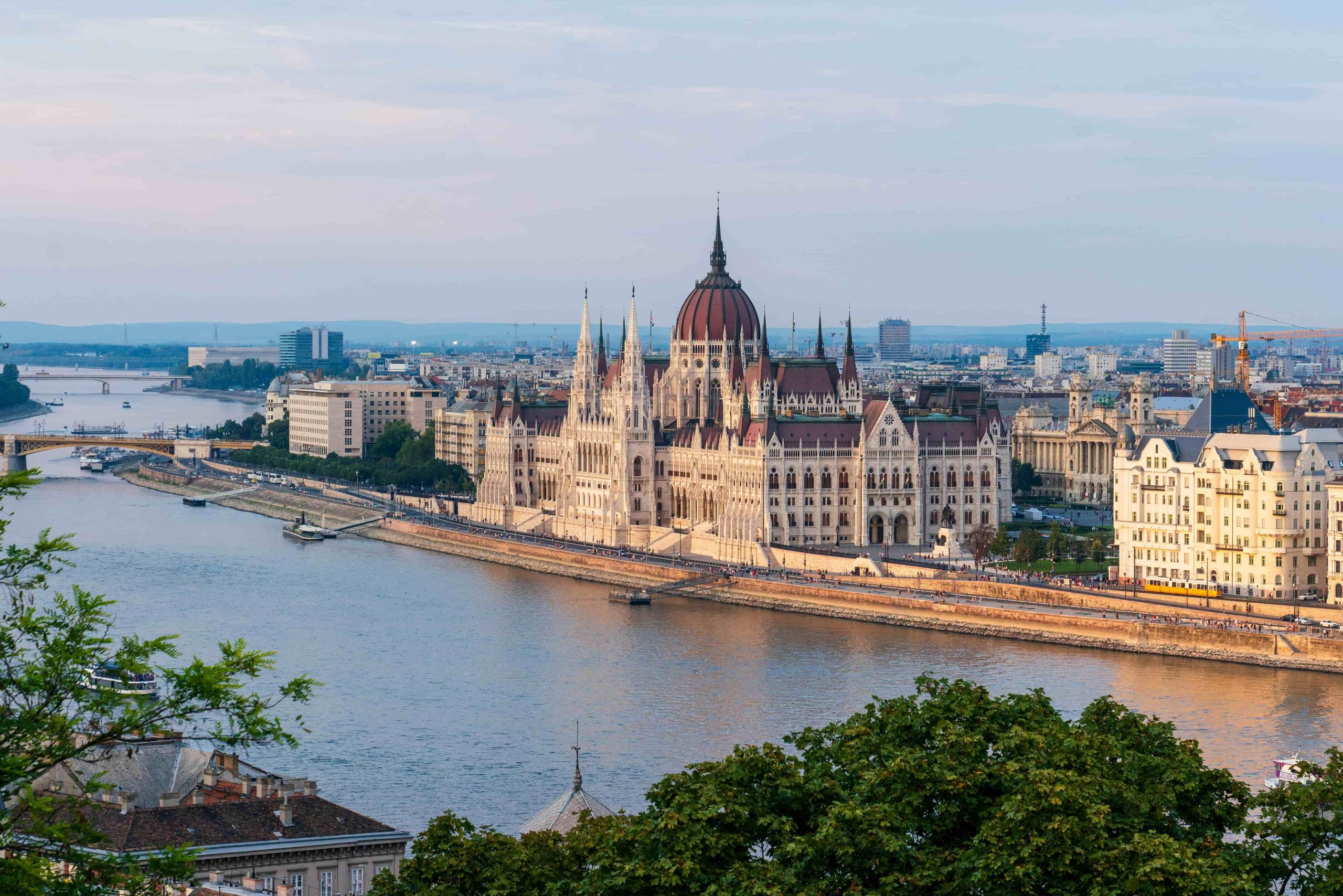
- Trams: The iconic yellow trams are a symbol of the city. Lines 4 and 6 run 24 hours a day along the Grand Boulevard — one of only a handful of all-night tram services in Europe. Tram 2, running along the Danube embankment with views of the Parliament building and Buda Castle, is widely considered one of the most scenic urban tram rides in the world.
- Trolleybuses: Budapest is one of the few cities still running a substantial trolleybus network, adding a quiet, emission-free layer to its urban transit mix.
- Suburban rail (HÉV): Four suburban railway lines fan out from Budapest into the wider metropolitan area, connecting commuters from surrounding towns.
- Bike sharing (MOL Bubi): In its first decade of operation, Budapest’s MOL Bubi bike-sharing scheme clocked 13.5 million journeys. In 2026, Budapest plans to double the current size of the fleet, reflecting surging demand for cycling as a last-mile option.
- Night buses: A reliable night network means the city stays connected well after the metro shuts down.
Going Digital: The BudapestGO App
Budapest has made a strong push into digital mobility with the BudapestGO app — available in English and widely used by both locals and tourists. The app provides real-time route planning, live departure times, digital tickets, service alerts, and accessibility information. Visitors can buy and validate tickets directly in the app, removing the need for paper tickets or validation machines entirely.
The city has also deployed around 300 new ticket vending machines citywide, accepting both cash and card, available 24/7 at major transport hubs and metro stations.
Smart ticketing integration with mobile wallets is on the roadmap, with more contactless and digital-first features being rolled out to bring the historic system fully into the modern era.
Affordability: A Feature, Not a Footnote
One of Budapest’s most overlooked transport strengths is price. A single metro ticket costs around 350 HUF (approximately €1). A 24-hour unlimited travel card is just 1,500 HUF (around €4.50), and a weekly pass costs around 4,950 HUF (€14.50). By global standards — and especially compared to Western European cities — this is extraordinarily affordable.
For families, a group 24-hour card covers five people for a full day of unlimited travel. Children up to 14 years old travel free with a valid Hungarian ID. Students and seniors benefit from heavily subsidised passes.
This pricing model keeps public transport genuinely accessible across income levels, maintaining high ridership and reducing car dependency in a city where traffic congestion is a growing concern.
Key Lessons From Budapest
1. Heritage is an asset, not a liability Rather than replacing M1 with a modern line, Budapest preserved and protected it — turning a 130-year-old underground railway into a UNESCO monument and tourist draw. History, handled well, becomes competitive advantage.
2. Multi-modal diversity builds resilience Metro, tram, trolleybus, suburban rail, bike sharing, and night buses — Budapest’s layered approach means no single mode failure cripples the system. Each mode fills a different gap.
3. Affordability drives ridership When public transport is genuinely cheap, people use it. Budapest’s fare structure keeps the system accessible to everyone, not just those who can’t afford a car.
4. Modernisation can coexist with history M3’s full renovation (2017–2023) shows that ageing infrastructure can be renewed without dismantling it. New trains, new signals, and refreshed stations — but the same line, the same routes, the same community it has always served.
5. Bikes and metros belong together MOL Bubi’s growth — and the plan to double the fleet in 2026 — shows how bike sharing and metro can reinforce each other as a seamless first-and-last-mile solution.
The Bigger Picture
Budapest’s metro is a reminder that great urban transit does not require being new. It requires being reliable, affordable, integrated, and respected. The city’s system is older than the aeroplane, yet it carries nearly half a billion passengers a year and continues to evolve.
As cities across Asia, Africa, and South Asia plan and build their own metro systems, the Budapest model offers a different but equally valuable lesson from Singapore or Monaco: you don’t always need to start from scratch. Sometimes, the most powerful thing you can do is take what you have — and make it extraordinary.
In Budapest, every metro ride is a journey through history. The train you board today runs on tracks laid more than a century ago — and it will probably still be running a century from now.