


By Enterprise Insider | Jan 2026
The Man Behind the Machine
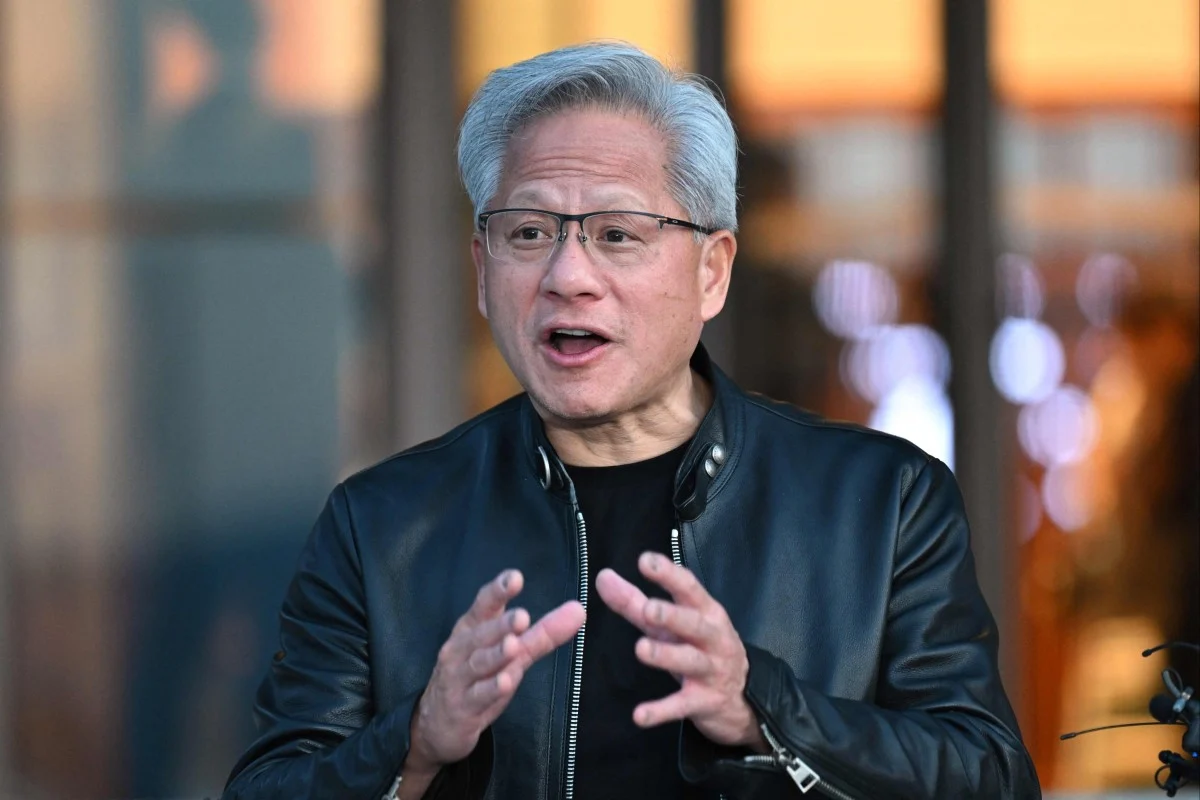
There is a leather jacket that has become as recognizable in Silicon Valley as Steve Jobs’ black turtleneck once was. It belongs to Jensen Huang — co-founder, President, and CEO of NVIDIA Corporation — and it has become something of a symbol: understated, durable, and built for the long game.
Born in Tainan, Taiwan in 1963, Huang immigrated to the United States as a child, washing dishes and busing tables to help his family make ends meet. He went on to earn a degree in electrical engineering from Oregon State University and later an M.S. from Stanford. In 1993, at just 30 years old, he co-founded NVIDIA with Chris Malachowsky and Curtis Priem in a booth at Denny’s — a detail Huang often recounts with unmistakable pride.
“We were so naive,” Huang has said of those early days. “And that naivety turned out to be our greatest asset.”
A Vision No One Else Had
In the early 1990s, the PC gaming market was booming, but graphics processing was fragmented and primitive. Huang saw what others didn’t: that the bottleneck of visual computing could be solved with a dedicated processor. Where rivals saw a niche hardware problem, he saw the future of computing itself.
NVIDIA’s first product, the NV1, launched in 1995, was a modest success. But it was the GeForce 256 in 1999 — branded as the world’s first “Graphics Processing Unit” or GPU — that announced the company’s arrival on the world stage. NVIDIA didn’t just make a faster graphics card. It invented a new category of computing hardware and named it.
By the early 2000s, NVIDIA had cemented its dominance in the gaming GPU market. The company went public in 1999 at $12 per share. Two decades later, that same share would be worth thousands of times more.
But Huang was never content to be the king of gaming.
The Pivot That Changed Everything
The real turning point came in 2006, when NVIDIA introduced CUDA — Compute Unified Device Architecture — a platform that allowed developers to use NVIDIA GPUs for general-purpose computing tasks far beyond rendering graphics. It was a quiet, almost academic-sounding release. Its implications were seismic.
Researchers in machine learning and deep learning quickly realized that the massively parallel architecture of a GPU was perfectly suited to training neural networks. While a traditional CPU handles tasks sequentially, a GPU can execute thousands of operations simultaneously — exactly what’s needed to crunch through enormous datasets.
By 2012, when a deep learning model called AlexNet won the ImageNet competition by a landslide — running on NVIDIA GPUs — the AI community took notice. The era of GPU-accelerated AI had begun.
NVIDIA didn’t stumble into the AI revolution. Huang saw it coming and ran toward it.
Building the Infrastructure of Intelligence
Throughout the 2010s, as AI moved from academic curiosity to commercial priority, NVIDIA methodically built the infrastructure that the world would come to depend on. The company introduced the Tesla line of computing accelerators for data centers, the DGX AI supercomputer system, and a succession of GPU architectures — Pascal, Volta, Turing, Ampere — each more powerful than the last.
The H100 Tensor Core GPU, launched in 2022 and built on the Hopper architecture, became the most sought-after piece of hardware in the world almost overnight. When ChatGPT launched in late 2022 and the generative AI boom exploded across every industry, every company building AI needed GPUs — and NVIDIA was the only company that had them at scale.
The results were staggering. NVIDIA’s data center revenue went from roughly $3 billion in fiscal year 2020 to over $47 billion in fiscal year 2024. The company’s market capitalization surged past $1 trillion in 2023, making it one of only a handful of companies in history to reach that milestone. By early 2024, it briefly became the most valuable company on the planet, with a market cap exceeding $3 trillion.
Jensen Huang’s Leadership Philosophy
What separates Jensen Huang from many of his Silicon Valley peers is his obsessive focus on long-term technology bets, often made years — sometimes decades — before the market catches up.
He speaks candidly about the near-death experiences that shaped the company. In the late 1990s, NVIDIA nearly went bankrupt twice. Huang has described those periods as crucial education, forcing the team to make decisions with extreme clarity and discipline.
His management style is famously flat. NVIDIA is known for having an unusually lean executive structure, with a large number of direct reports feeding into Huang himself. He believes that the best ideas don’t emerge from bureaucracy — they emerge from proximity to the work.
“Speed of learning is the most important thing,” Huang has said in interviews. “The ability to absorb information, process it, and make decisions faster than anyone else — that’s the competitive advantage.”
He is also a vocal champion of intellectual humility. In a culture where executives often project invincibility, Huang regularly speaks about failure, uncertainty, and the importance of being willing to be wrong. It is this combination of bold vision and grounded pragmatism that has defined NVIDIA’s culture for over three decades.
The Numbers Tell the Story
| Milestone | Year | Detail |
|---|---|---|
| Founded | 1993 | Co-founded in a Denny’s diner, Santa Clara |
| IPO | 1999 | Listed on NASDAQ at $12/share |
| CUDA Launch | 2006 | Opened GPUs to general-purpose computing |
| First $1B Revenue Quarter | 2017 | Driven by gaming and data center growth |
| $1 Trillion Market Cap | 2023 | Became the 7th company in history to reach this milestone |
| Peak Market Cap | 2024 | Briefly surpassed $3 trillion |
The Road Ahead
NVIDIA today is far more than a chipmaker. It is a platform company — the foundation upon which much of the world’s artificial intelligence is being built. Its software ecosystem, including CUDA, cuDNN, and the AI Enterprise suite, creates deep integration across research institutions, cloud providers, and enterprise customers worldwide.
The company’s newest Blackwell GPU architecture, unveiled in 2024, promises another generational leap in performance for AI workloads. Meanwhile, NVIDIA is pushing into autonomous vehicles, robotics, digital twins, and sovereign AI infrastructure — the idea that nations, not just corporations, need their own AI computing capacity.
Huang has spoken of a future where every industry is transformed by AI: healthcare, manufacturing, climate science, drug discovery. NVIDIA intends to be the engine running that transformation.
For a company that once sold graphics chips to gamers in the 1990s, it is a breathtaking ascent. But for those who have followed Jensen Huang’s career, it feels less like a surprise and more like the logical conclusion of a very long, very deliberate plan.
A Legacy Still Being Written
Jensen Huang turns 63 this year. In an industry that often celebrates youth and celebrates disruption for its own sake, he is something rarer: a founder-CEO who has steered the same company through multiple technology cycles, market crashes, near-failures, and paradigm shifts — and emerged each time stronger.
He still wears the leather jacket. He still gives technical keynotes that feel more like rock concerts than corporate presentations. And he still speaks about the future with the urgency of someone who believes the most important chapter is always the one being written right now.
NVIDIA’s story is, in many ways, the story of modern technology itself: the unexpected intersection of gaming, science, and human ambition — held together by one man’s refusal to think small.
“The more you buy, the more you save.” — Jensen Huang, on NVIDIA GPU infrastructure, tongue firmly in cheek.
© 2026 Enterprise Insider. All rights reserved. This article is intended for informational and editorial purposes.